



AI in brand copy: when it adds value, when it undermines trust and where to lead with human thinking.

By Dianne Lucas and Tim Braithwaite
AI writing is everywhere now. You can hear it in the neatness of the sentences, the way the words click into place, and the quiet sense that everything sounds right yet somehow feels empty, which is precisely the problem facing brands today as generative AI moves from novelty to normality and begins to shape not just how content is created, but how it is interpreted, trusted and remembered by audiences.
Put simply: most AI writing is acceptable and that is another way of saying forgettable, because when everything sounds right nothing stands out and in a market where distinctiveness is already under pressure, this creates a new and very real commercial risk of brands drifting into a sea of sameness rather than building meaningful difference.
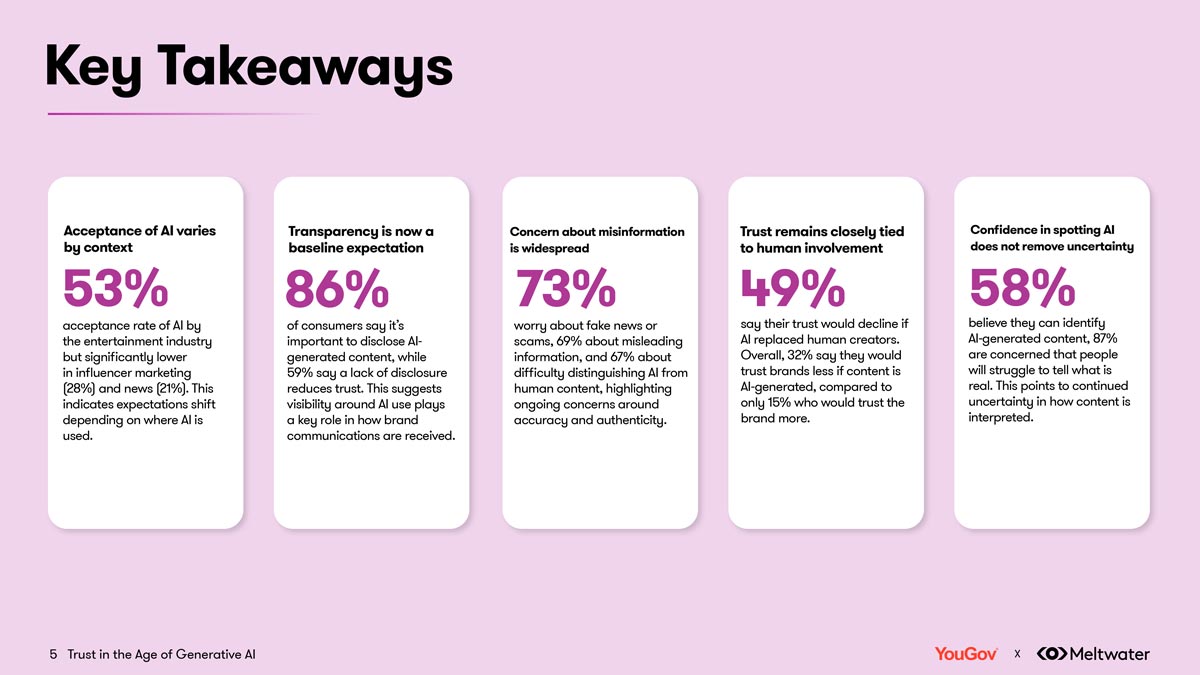
The data supports this growing tension between efficiency and impact. YouGov’s 2026 research shows that while AI is recognised for accelerating content creation and improving productivity, trust remains closely tied to human involvement, with 32 percent of consumers saying they would trust a brand less if its content were AI generated, compared to only 15 percent who would trust it more.
At the same time, concern about authenticity is widespread, with 69 percent of people worried that AI generated content may be misleading and 67 percent concerned about not being able to distinguish between human and machine created content, reinforcing the idea that the challenge is not simply adoption, but how and where AI is used within brand communication.
This is where judgement becomes the dividing line. AI can speak volumes, but it cannot decide what deserves to be said and without that layer of intent, prioritisation and care, brands are left with a probability machine that rewords what already exists rather than creating something that genuinely moves thinking forward.
Methodology
- Multi-market study across 7 countries (UK, US, Australia, Canada, France, Germany, Singapore)
- 9,869 adults surveyed online between 26 Feb – 5 March 2026 What the data tells us
Key findings for brands
- Trust, authenticity and transparency are emerging as the defining battlegrounds for brands
- 32% trust brands less when content is AI-generated vs. only 15% more
- 59% say trust falls when AI use is not disclosed
- 49% say trust declines if AI replaces human creators entirely
- 73% worry about fake or misleading content, and 69% about accuracy
- 67% are concerned about not being able to distinguish AI from human content
Acceptance depends on context
- More acceptable in functional use cases (e.g. product content, efficiency-driven tasks)
- Significantly less acceptable in high-trust or opinion-led environments (e.g. news, thought leadership)
Where AI adds clear value
There is no question that AI has an important role to play within modern marketing ecosystems, particularly where scale, speed and consistency are required.
Used well, these applications enhance productivity without diluting meaning, allowing teams to focus more time on higher order thinking and strategic creativity.
Where AI should not lead
However, the same data shows that trust becomes more fragile as AI moves closer to core brand expression, especially in areas where authenticity, emotional connection and differentiation matter most.
In these spaces, reliance on AI alone risks creating technically correct but emotionally weightless output, the kind that audiences do not interrogate but simply forget.
This matters because differentiation is not a cosmetic layer, it is a commercial asset. In a communications environment already grappling with competing priorities and shifting attention, as highlighted in our work with industry groups, the ability to communicate something meaningful, relevant and human is what ensures that messages land and actions follow.
The YouGov data reinforces this, showing that 59 percent of consumers say trust declines when AI use is not disclosed and nearly half say trust would fall if AI replaced human creators entirely, which underlines a simple but critical point: audiences are not rejecting AI, but they are recalibrating where they expect human intelligence to lead.
Ultimately, the brands that succeed will not be those that use AI the most, but those that use it with the most discipline, combining its efficiency with the judgement, empathy and originality that only people can bring.
Because the real risk is not sounding like AI.
It is sounding like everyone else.
AI is everywhere
By Tim Braithwaite, CMDi Head of Copy
AI writing is everywhere now.
You can hear it.
The words are neat and clean.
They click into place.
The paragraphs are full of promise,
yet somehow feel empty.
There’s a curious weightlessness to the words.
As if no one really thought that.
Or cared enough to mean it.
Most of the writing is acceptable.
Which is another way of saying forgettable.
Because when everything sounds right,
nothing stands out.
Sure, AI can speak volumes.
What it can’t do is decide what deserves to be said.
That requires judgement.
Without it, you are left with a probability machine.
Playing it safe.
Rewording what already exists.
Guessing what your brand wants.
Unable to discern what it needs.
Not actually caring what’s delivered.
Your audience won’t analyse such writing.
They’ll just forget it.
The problem? It isn’t artificial intelligence.
It’s the need for actual intelligence.
For three decades, this has been CMDi’s work.
Finding what matters.
Deciding what doesn’t.
And shaping what’s worth saying in the first place.
Because the real risk isn’t sounding like AI.
It’s sounding like everyone else.
If this feels familiar,
we should talk.
Get in touch today
You can request:
- an introduction to CMDi
- a personal brand strategy overview of the CMDi approach, or
- a team workshop tailored to your organisation
Growth doesn’t come from shouting louder. It comes from being clearer.
Let’s sharpen your brand and unlock the growth that comes with it.